
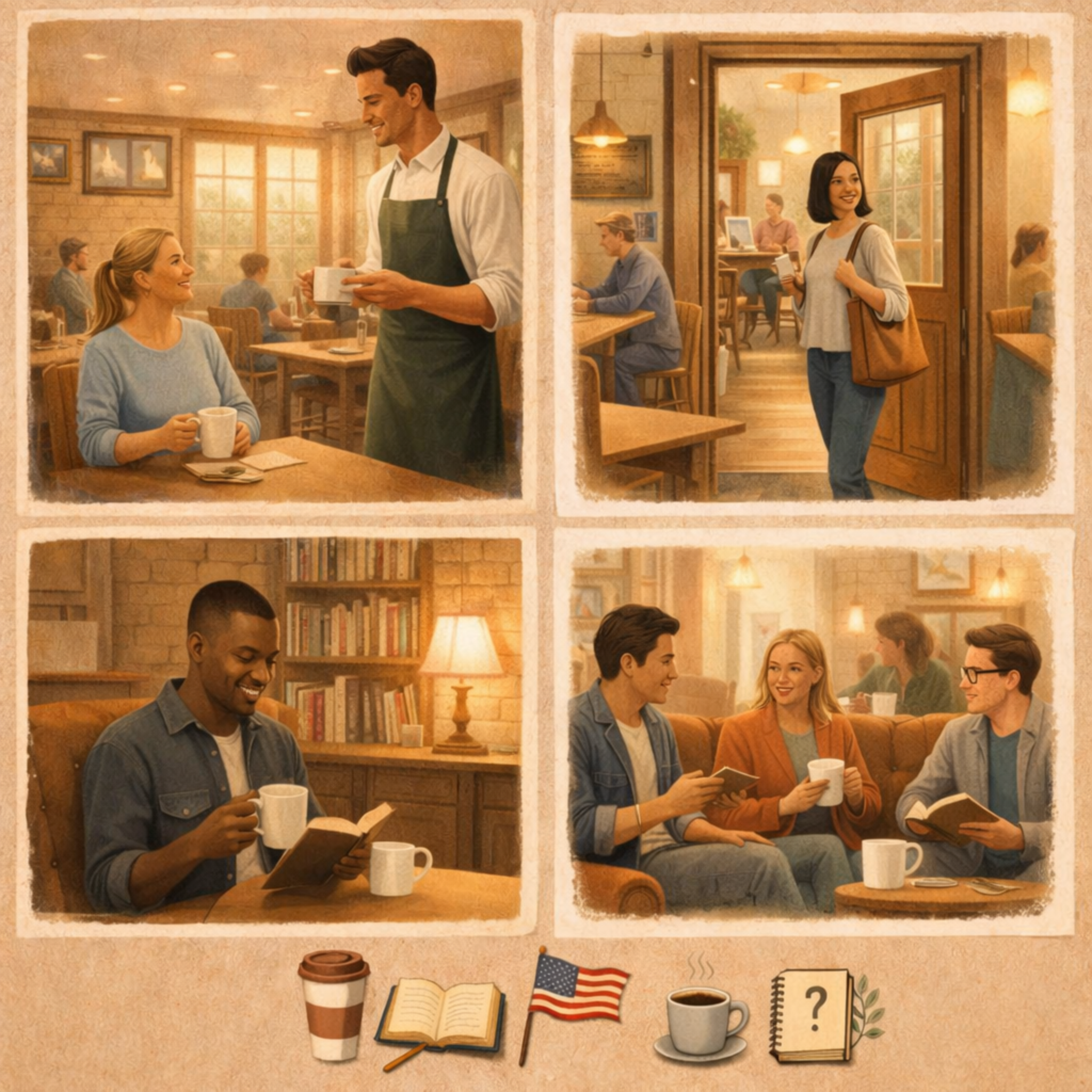
Today you are not learning a list of facts about America. You are learning how to notice culture through ordinary moments. Before we start, let's first go over today's objectives and cultural rhythms.
What is American Culture to You?
Take two or three minutes to write down what you already assume about American culture. Then set those assumptions aside, and click through the five Cultural Fluency rhythm skills we will use throughout this course.
The Cultural Fluency Rhythm
Throughout the exercises, we will return to these same five skills. Click each box to flip it and reveal the guiding question.
Observe: Pause at the Entrance
Study the scene below. Click either image to enlarge it. Take a minute or two to notice what you see. After, write your observations.
Listening Prompt
Click the buttons to hear common phrases used when opening doors for others in America.
1. Door Observation
What Does the Room Teach You?
You have now entered the café. Before anyone speaks to you, the room is already teaching you something. Look closely at the counter, the line, the menu, and the spacing between people to gather clues about the culture.
Click to Explore
Click each tile to flip it and reveal what is typical in many American cafés.
In My Culture...
Click the statements that feel true in your culture.
Your Notes
How Cultures Organize Public Space
Different cultures solve the same social problem in different ways. Some cultures value clear turn-taking through lines. Others rely more on crowd flow, flexible movement, and social negotiation. Personal space works the same way: different systems, different meanings, both serving a purpose.
Line Culture vs Crowd Flow Culture
These are not “better” or “worse” systems. They are different ways of organizing fairness, movement, and access.
Line Culture
Crowd Flow Culture
Different Ways of Managing Distance
Distance communicates meaning: comfort, warmth, respect, or modesty depending on the culture.
American Boundaries
Other Cultural Boundaries
Pop the 'American Bubble': American Social Cues
Click each floating bubble to reveal one body-language insight about American social space.
Personal Space
Your Reflection
Different cultures soften requests differently
In some cultures, it can feel rude to make a request before asking about health, family, or general well-being. In many American settings, though, that kind of personal check-in is uncommon before the request. before the request. A short greeting usually does the work, and then the request comes quickly after.
Sample interaction
Barista: “Hi, how are you?”
Customer: “Good, can I get a latte?”
Barista: “Sure — what name should I put on it?”
An Introduction to Request Styles
A request can be softened in different ways. Neither system is automatically rude, but they can feel rude to each other if you do not know the local pattern.
In some cultures
- Say hello first
- Ask about family, health, or life
- Prioritize relationships
- Make the request
In many American service settings
- Say hello
- Ask “How are you?”
- Request comes quickly
- Speed can sound polite
Which version sounds most natural in the American context?
Click through versions A-C to learn which conversations are the most appropriate for this cultural dynamic. Remember: The goal is not to judge people. The goal is to notice what fits this specific setting.
Barista: “Hi, how are you?”
Customer: “Good, can I get a latte?”
Why: It answers the greeting briefly and moves smoothly into the order.
Barista: “Hi, how are you? How is your health? Is your family doing ok?”
Customer: “My health and family are good! How about yours? I hope your week is going well.”
Why: In some cultures this sounds respectful. In an American setting, it usually feels longer and more personal than expected.
Barista: “Hi, how are you?”
Customer: “Latte.”
Why: The order is clear, but it removes the small polite bridge that many Americans expect.
Match the Request Style to its Meaning
Click one sentence on the left, then click the matching cultural meaning on the right. There are 3 matches.
Try one: match each sentence to the cultural meaning that fits it best.
Why Directness Can Sound Respectful

In many American settings, being brief can sound respectful because time is treated as valuable. To an American, a short greeting plus a clear request can feel polite, efficient, and considerate.
Social Navigation and Café Etiquette
Now that you have your drink, it is time to notice what happens next. In this section, you will explore how people behave in American cafés, including where they sit, how long they stay, how they interact with others, how they clean up, and how they show politeness.
Follow the path from order to exit. Complete each glowing checkpoint before you leave the café.

Below are three images. Guess what café faux pas happened, then flip to see what went wrong.
Unlocked after you finish the pathway.
You made it through the café!
You passed all six checkpoints. Great job noticing social navigation, cleanup, politeness, and tipping culture in an American café.
Café Etiquette Pathway
Complete each checkpoint before you leave.
Your Notes
Tipping is Part of the Social Message
In the U.S., a tip often communicates appreciation for service, but many Americans also debate whether tipping is fair, and when businesses should simply pay workers more.
Checkpoint title
Do or Don’t? Sort What You Learned
Review sections 1–6 by dragging each mixed tile into the correct column. If a tile lands in the wrong place, it will shake and return to the tray.
Do
Don’t
You sorted every tile.
You just reviewed door behavior, line culture, personal space, ordering rhythm, polite requests, cleanup, and tipping awareness from sections 1–6.
Congratulations on Completing Session 1

You completed the Cultural Fluency café experience. Thank you for learning with curiosity, empathy, and respect.
A Message From Brittani
Thank you for taking part in this course. Every time we learn about another culture with openness instead of judgment, we build stronger human connections. I hope this experience helped you feel more confident, more curious, and more prepared to move through social spaces with empathy and respect.
Downloads
Download your certificate of completion or save your session notes before you go.